Sebastiano De Albertis
(Milan, 14 January 1828 - 29 November 1897)
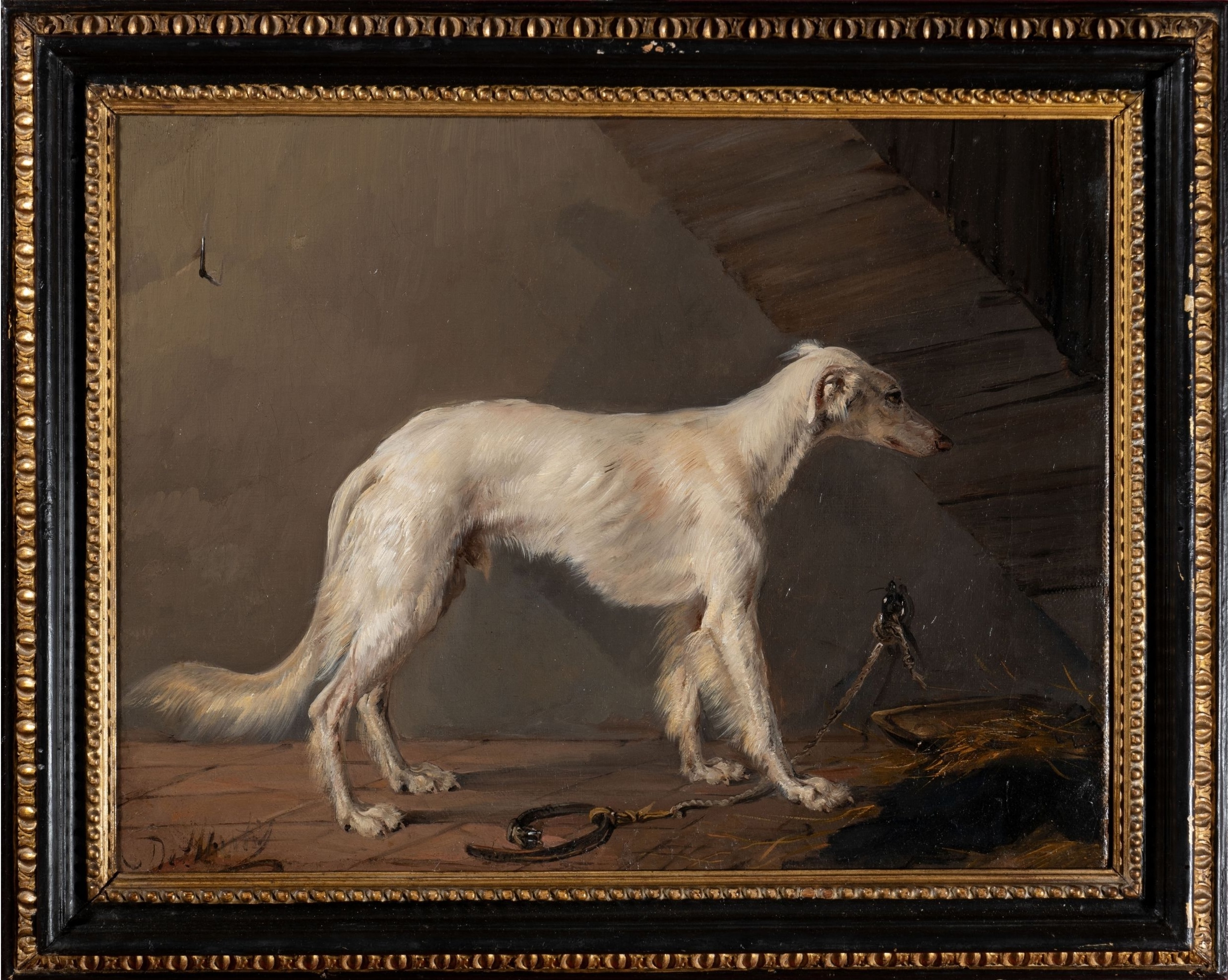
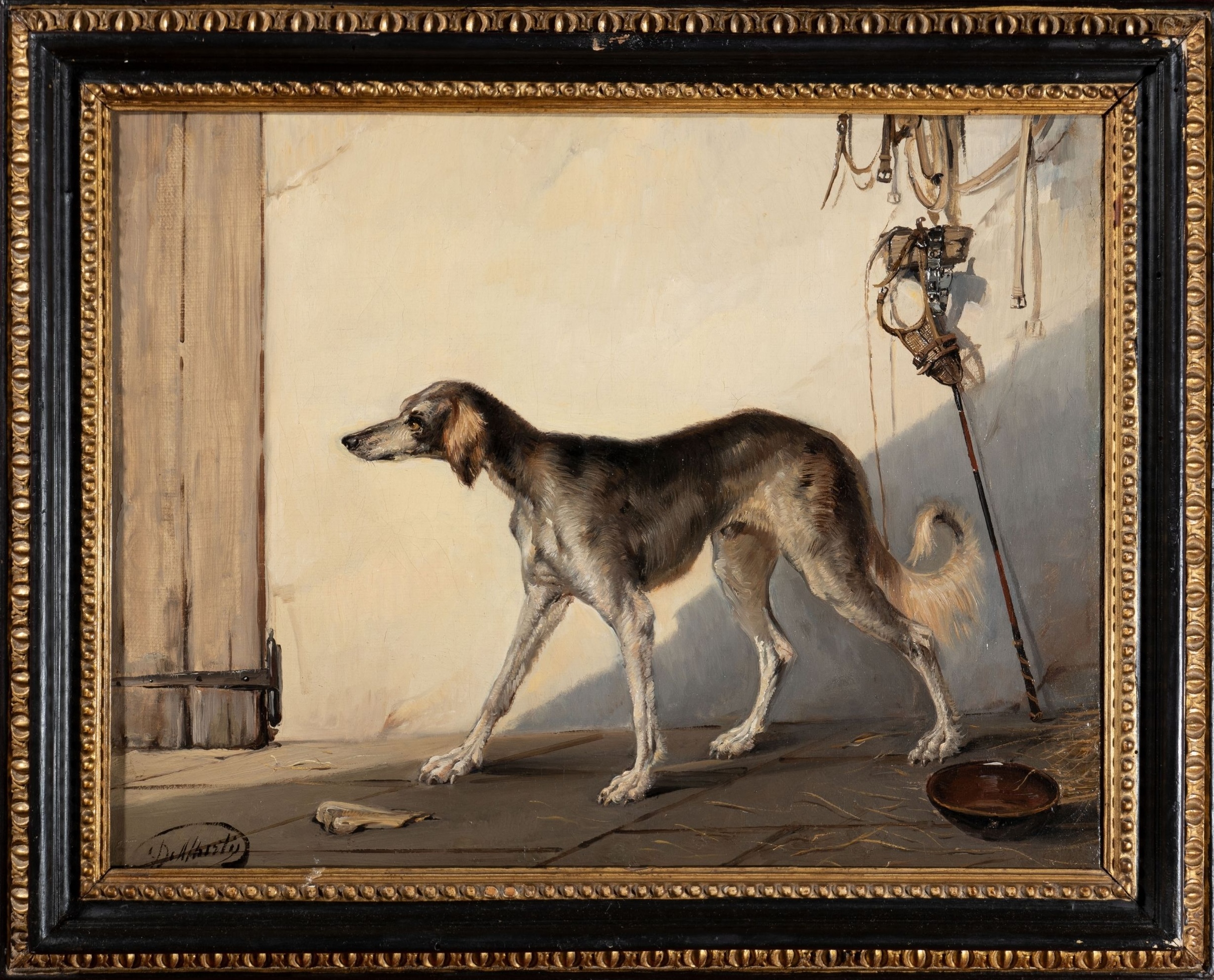
Two Greyhounds
oil on canvas, 33,5 x 43,5 cm (both signed and dated low left: De Albertis)
These two magnificent paintings depicting two greyhounds, which we present today, are undoubtedly the work of the Milanese painter Sebastiano De Albertis.
Sebastiano was a student at the Accademia di Belle Arti di Brera. Simultaneously, he studied under the historical painter Roberto Focosi and Domenico and Gerolamo Induno. Initially, his presence at the Esposizioni di Belle Arti di Brera, showcasing historical subjects with civil commitment, was sporadic due to his involvement as a volunteer in the Risorgimento movements and wars of independence. Since 1855, he dedicated himself to the military-patriotic genre with a rich repertoire of battles, replicated in various variations, which progressively became his specialization. Upon his return to Milan, he joined the "Società della Confusione," with Tranquillo Cremona and Eleuterio Pagliano, later institutionalized as the "Circolo degli Artisti" in 1875.
Within this cultural milieu revolving around the Scapigliatura movement, De Albertis' first attempts with watercolor and his more relaxed production, characterized by themes of customs and contemporary life, such as the famous horse races, date back. Following the premature death of his only son, Enrico, in 1874, there was a return to a painting with a patriotic character, of strong civil significance. In 1880, he painted "La Carica di Pastrengo" (April 30, 1848), exhibited at the Museo Storico dell'Arma dei Carabinieri. Endowed with numerous official recognitions, in 1884, he became part of the Commission for the establishment of the Museo del Risorgimento di Milano. In 1887, he painted "Scena militare," exhibited at the Museo Cantonale d'Arte di Lugano.
In 1896, shortly before his death, he painted the standing portrait of Cavaliere Francesco Ponti (1832-1895) for the art collections of the Ospedale Maggiore di Milano.
The two paintings can be dated, based on stylistic comparisons with other works by the artist, around 1870. It is indeed appropriate to associate our two dogs with a large painting dated 1872, also signed at the bottom left and depicting a theme dear to the artist, namely horses in the stable.
In 1934, the Galleria Dedalo in Milan exhibited the painting, later offered by Sotheby’s in 2006, describing it as follows: "The horses are drawn and defined with the confidence possessed by one who, having studied them at length, can capture those instantaneous attitudes that are of great effectiveness. The harmonious, robust, and sparing color is exquisitely true, revealing the Induno taste." Although in our two paintings, the main subjects are not horses but dogs, we still consider this statement truthful.
The fundamental difference in the approach to the two paintings is the pursuit of movement versus the search for naturalism. It is evident that in our greyhounds, De Albertis aims to provide his audience with two accurate and precise studies, paying less attention to the dynamism of the scene. Nevertheless, it remains easy to infer that our two dogs are painted just outside a stable; clues such as the hay, whip, and reins to the right of the greyhound cannot be ignored.
It is also interesting to note that he chooses a light background for the greyhound and a dark one for the white one, creating a strong contrast that allows us to appreciate furtherly the form of the two animals and, consequently, his painting skills.
In conclusion, we can affirm that these two interesting studies represent a fundamental addition to De Albertis's catalog, two paintings executed during his artistic maturity, which today represent one of the highest points of the Milanese painter's career.