Charles M. McArthur
British, active c. 1860-1880
St. Mark's, The Stairs of the Ducal Palace; a pair
watercolour on paper, 51 x 73 cm
A pair, one signed and dated 1882
Watercolour on paper
51 × 73 cm
Titled and inscribed by the artist on the reverse
Provenance: London, UK
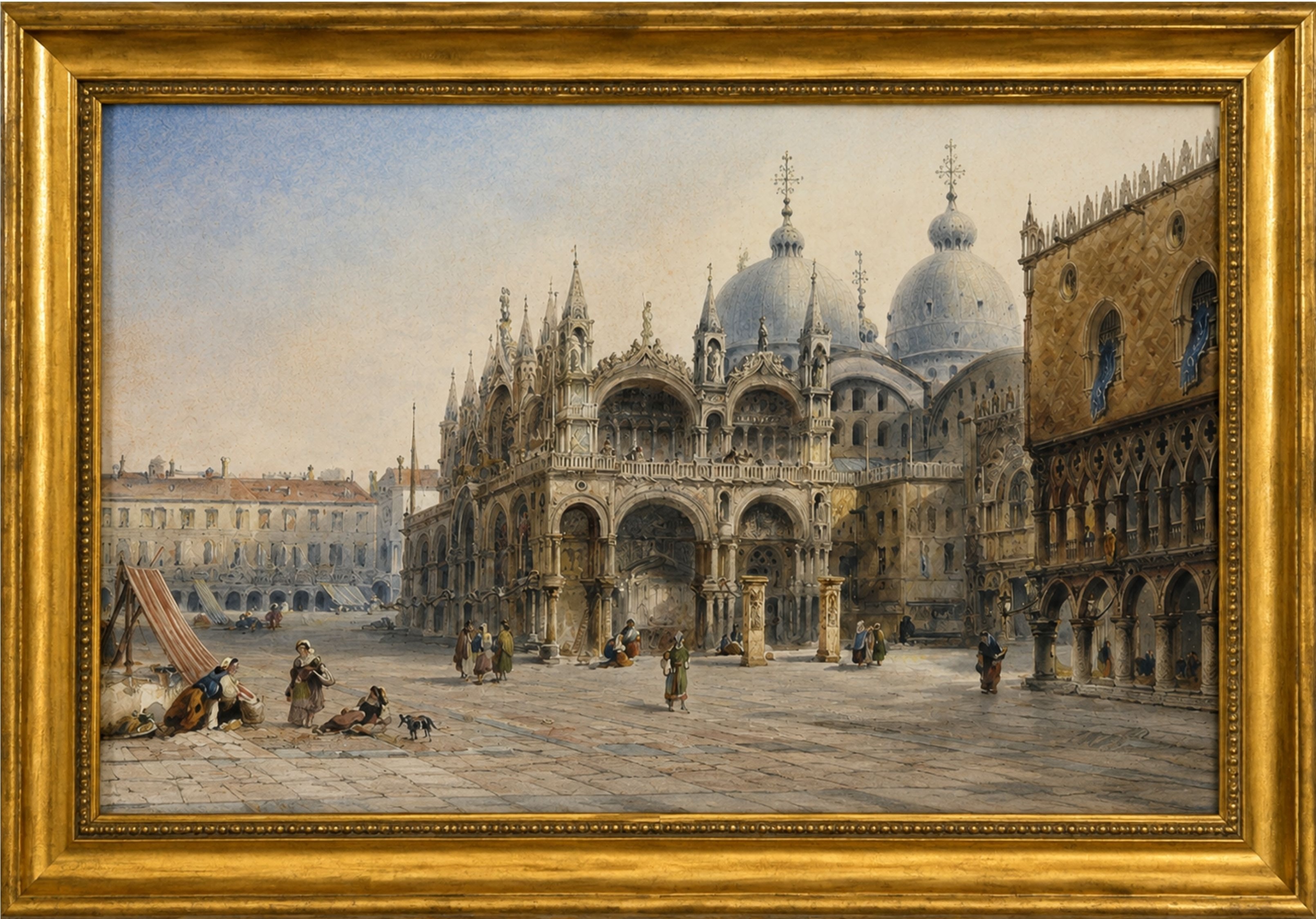
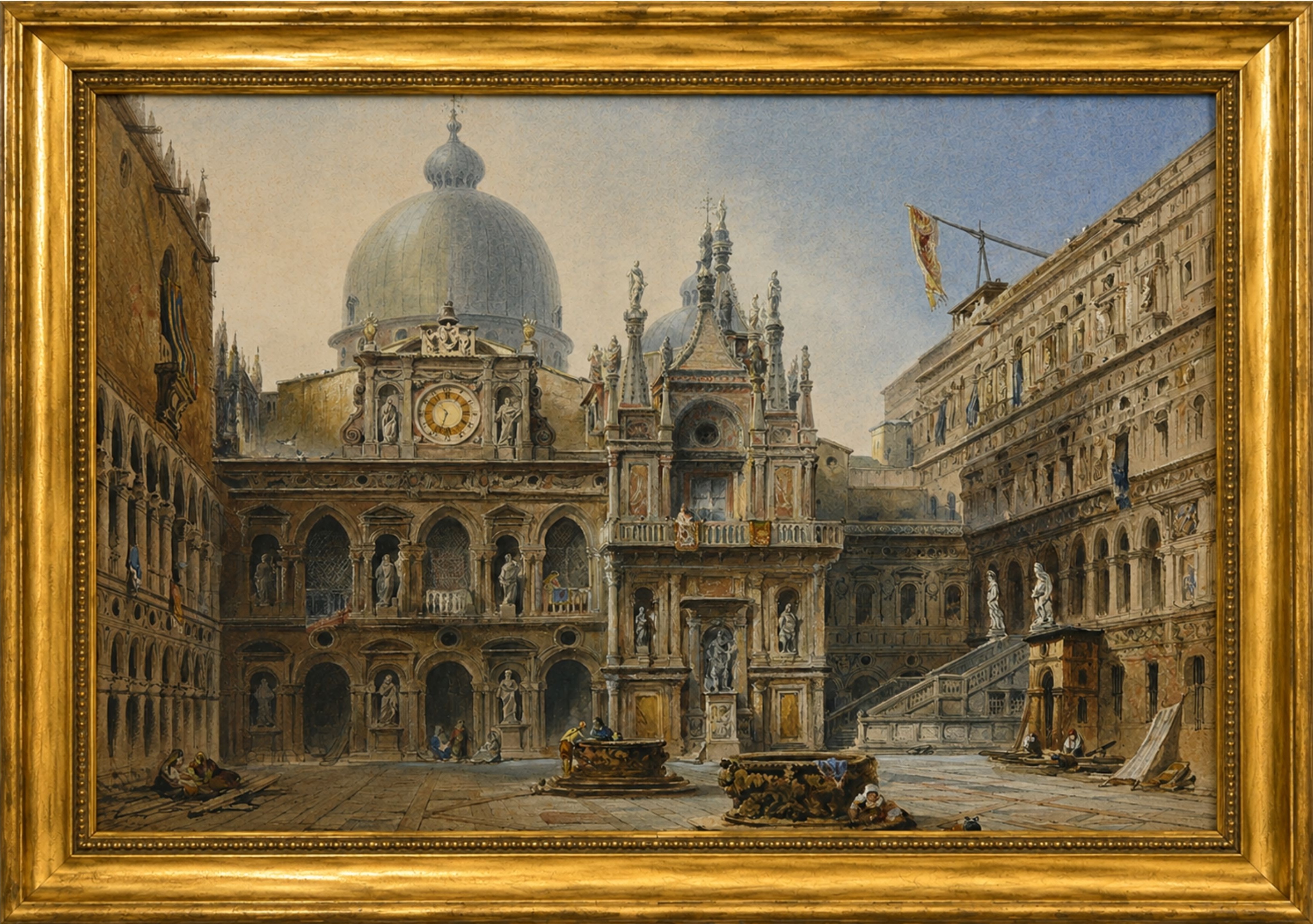
The present pair of watercolours by Charles M. McArthur belongs to the rich tradition ofnineteenth-century British views of Venice, a city whose architecture, light and historicalassociations exerted an extraordinary fascination upon generations of visiting artists.Rather than embracing the expansive panoramas of the Grand Canal favoured by theeighteenth-century vedutisti, McArthur brings the spectator into the very heart of theSerenissima, choosing two intimately connected views of its political and religiouscentre: the Basilica of San Marco and the courtyard of the Doge’s Palace.The two compositions are conceived as pendants not merely through their identicaldimensions and technique, but through a carefully constructed dialogue of viewpoints.In St Mark’s, Venice, McArthur approaches the Basilica obliquely, concentrating upon itssouthern flank and the complex succession of arches, pinnacles and domes that risesabove the Piazzetta. The adjoining façade of the Doge’s Palace closes the compositionat right. Its warm brickwork and deeply shadowed arcades provide a chromatic andarchitectural counterpoint to the pale, almost ethereal mass of San Marco.In The Stairs of the Ducal (Doge’s) Palace, Venice, the artist effectively crosses thethreshold of the building glimpsed in the first sheet and turns his attention to its internalcourtyard. The composition centres upon the richly decorated façade incorporating thegreat clock and, beside it, the monumental structure adjoining the Scala dei Giganti. Thearchitecture encloses the spectator on three sides, while the great dome of San Marcorises unexpectedly beyond it. The relationship between the two watercolours istherefore particularly effective: each monument appears within the other’s domain. TheDoge’s Palace frames San Marco in the first view, while the domes of the Basilica presideover the palace courtyard in the second.McArthur’s approach reflects the transformation that Venetian view painting underwentduring the nineteenth century. For the eighteenth-century masters, above all Canaletto,Michele Marieschi and Francesco Guardi, the veduta had celebrated Venice as a livingpolitical and ceremonial capital. By McArthur’s generation, the Republic had long sincedisappeared, and the same monuments had acquired a different resonance. Venice wasincreasingly perceived through the overlapping lenses of history, memory and travel: anextraordinary survival from an earlier civilisation whose architecture itself had becomethe principal protagonist.The British response to the city was particularly intense. From Turner to Ruskin and thenumerous painters who followed them to the Lagoon, Venice offered a seeminglyinexhaustible combination of architectural splendour and atmospheric effects.McArthur’s watercolours belong to this cultural milieu, yet reveal a markedly individualpreference for architectural description. The buildings are observed with considerableprecision, but without the dryness of a purely topographical record. Details dissolveprogressively into light, allowing the solidity of stone and brick to coexist with theatmospheric qualities inherent to the watercolour medium.This balance is particularly successful in St Mark’s. The intricate Gothic and Byzantinevocabulary of the Basilica is painstakingly articulated in the lower portion of the buildingbefore gradually losing definition as the eye ascends towards the domes. Thesemonumental forms are rendered in delicate blue-grey washes and seem almost tomerge with the luminous Venetian sky. The effect gives the architecture an unexpectedlyweightless character: San Marco appears simultaneously substantial and evanescent.The companion view is more strongly enclosed and consequently more theatrical. Herethe vertical accents of the courtyard façades and the monumental staircase establish acomplex architectural stage. McArthur exploits the contrast between the shadowedarcades at ground level and the brilliant upper reaches of the buildings, while theenormous dome visible beyond the courtyard provides both a compositional anchorand a reminder of the proximity of the Basilica. The Venetian flag fluttering above thepalace adds a vivid note of colour and reinforces the historical identity of the setting.Particularly revealing in both works is the treatment of the staffage. McArthur populateshis monumental settings with numerous small figures—women conversing, seatedfigures, passers-by and individuals engaged in the ordinary activities of daily life. Theyare subordinate to the architecture yet essential to the atmosphere of the compositions.Their presence establishes scale, but more importantly prevents these celebratedmonuments from becoming archaeological relics. The historic city remains inhabited.There is, indeed, an appealing tension between monumentality and anecdotethroughout the pair. McArthur records some of the most celebrated architecture inEurope, yet deliberately avoids presenting it with excessive solemnity. In the foregroundof St Mark’s, figures sit or converse beneath the enormous mass of the Basilica, while asmall dog crosses the square. In the courtyard of the Doge’s Palace, the protagonists ofVenetian history have disappeared and ordinary figures now occupy the space onceassociated with the government and ceremonial life of the Republic. The grandeur ofthe Serenissima survives in its architecture, while contemporary life continues almostcasually around it.Colour plays an important role in establishing this mood. McArthur employs a restrainedrange of ochres, pale blues, greys and warm earth tones, punctuated by moreconcentrated passages of red, yellow and blue in the figures, banners and architecturaldetails. The extensive areas of exposed or lightly washed paper create the sensation ofthe brilliant, diffused light for which Venice was celebrated by nineteenth-centurywatercolourists. Particularly characteristic is the contrast between the cool blue of thesky and domes and the warmer tones of the brick and stone façades.The substantial dimensions of the sheets—51 by 73 cm—are also significant. These arenot slight travel sketches but ambitious, highly finished exhibition watercolours. Theirscale allowed McArthur to reconcile minute architectural observation with broadatmospheric effects, while their conception as a pair gives them an unusually coherentnarrative character.One of the works bears the date 1882, placing the pair at a moment when Venice hadbecome firmly established as one of the essential destinations of the internationalartistic imagination. Yet McArthur's vision remains indebted to the fundamental principleof the eighteenth-century Venetian veduta: the transformation of a recognisable placeinto a carefully orchestrated pictorial experience. What has changed is the meaning ofthat experience. The city is no longer presented as the triumphant stage of a livingRepublic, but as a place in which the splendour of the past continually intrudes upon theeveryday life of the present.Taken together, the two watercolours consequently amount to more than independentarchitectural views. McArthur constructs a complementary portrait of the symboliccentre of Venice, moving from the exterior splendour of San Marco to the secludedceremonial architecture of the Doge’s Palace. Church and State, Basilica and Palazzo,public square and internal courtyard are bound together through reciprocal viewpoints,light and human presence. The result is an evocative vision of nineteenth-century Venicein which topographical precision is softened by atmosphere and the physical survival ofthe Serenissima becomes the vehicle for a distinctly modern sense of historical memory.