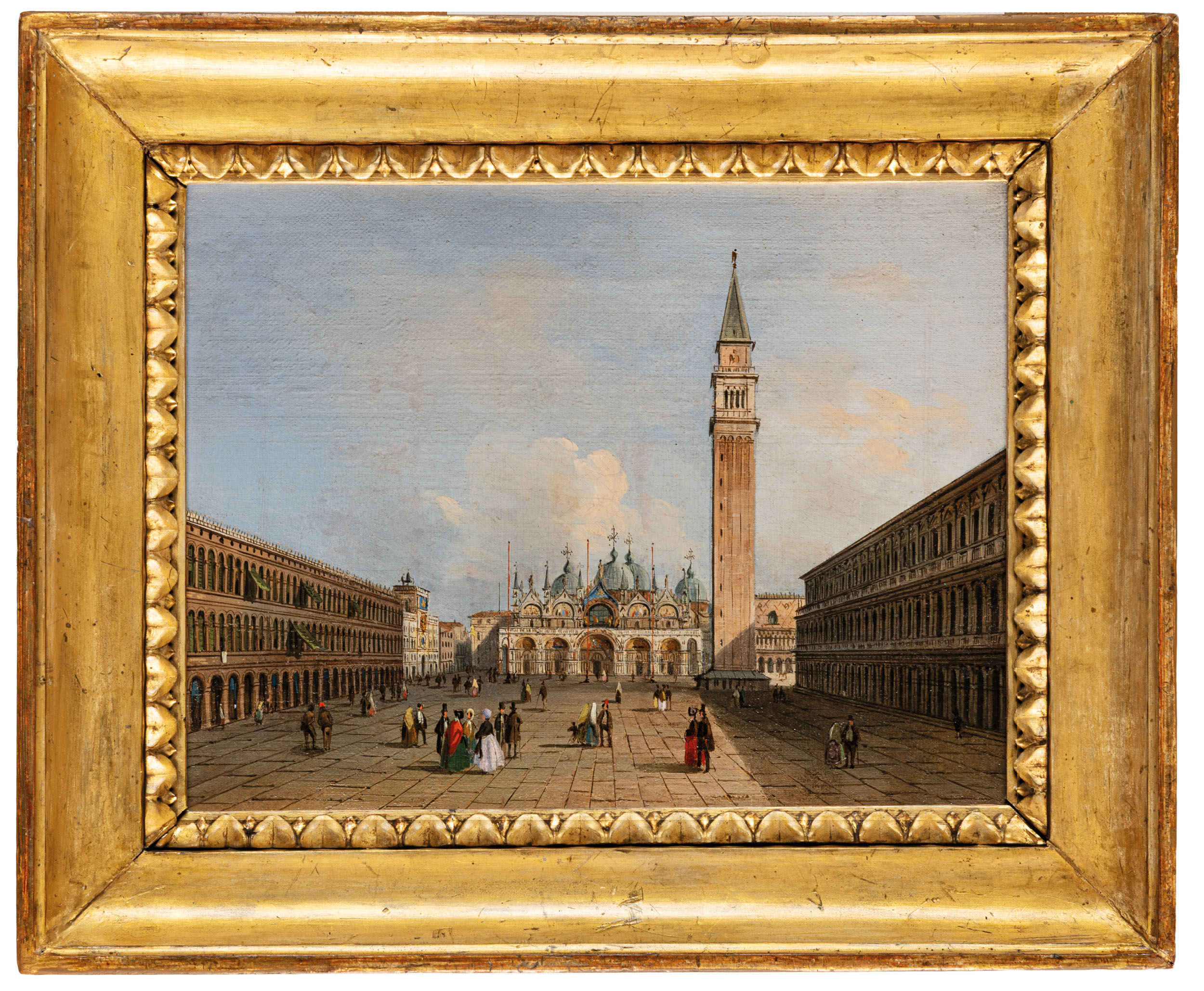

Giuseppe Bernardino Bison
(Palmanova, 1762 – Milan, 1844)
Piazza San Marco looking East
oil on canvas, 20 x 27,5
This refined view of Piazza San Marco represents one of the finest and most accomplished achievements of Giuseppe Bernardino Bison’s Venetian production. Bison was among the most original and versatile artists active in Italy between the late eighteenth century and the first half of the nineteenth century. The composition depicts the celebrated monumental heart of Venice through a carefully balanced central perspective, with St Mark’s Basilica and the Campanile emerging luminously at the centre of the scene, framed by the long arcades of the Procuratie.
The painting exemplifies the qualities that established Bison as one of the most highly regarded interpreters of the Venetian veduta of his age. The artist combines the rigorous perspectival discipline inherited from the great eighteenth-century tradition inaugurated by Canaletto and Bellotto with a more modern and lyrical sensibility, evident in the clarity of the atmosphere, the delicacy of the light, and the lively narrative presence of the small figures that animate the square.
Particularly remarkable is Bison’s ability to impart a sense of monumentality to the scene despite its modest scale. The vastness of Piazza San Marco is conveyed with extraordinary effectiveness through the measured articulation of the architecture and the careful distribution of the figures, which introduce an element of elegant everyday life without diminishing the solemnity of the monumental setting. Clear, diffused, crystalline light envelops the entire composition, enhancing the warm tones of the architecture and the delicate chromatic accents of the costumes.
This view is of particular interest in light of Giuseppe Bernardino Bison’s position within the history of Venetian vedutismo. Active during a crucial period between the fall of the Venetian Republic and the Napoleonic era, Bison stands as the last great interpreter of a tradition whose foremost exponents had been Canaletto, Bernardo Bellotto, Michele Marieschi, and Francesco Guardi. Unlike the masters of the eighteenth century, however, he did not merely perpetuate their models; rather, he profoundly renewed them by introducing a freer, more painterly, and more sentimental sensibility.
In Bison’s works, topographical accuracy—the defining feature of the eighteenth-century veduta—gradually gives way to a more atmospheric and poetic conception of the urban landscape. The city is no longer simply described but evoked through effects of light, subtle chromatic variations, and an extraordinary immediacy of execution that in part anticipates the developments of nineteenth-century painting. In this respect, Bison serves as a genuine link between the Enlightenment vedutismo of the eighteenth century and the new Romantic sensibility of the century that followed.
His significance lies precisely in his ability to transform an established genre into a more intimate and lyrical mode of expression, in which architectural precision coexists with an emotional perception of space and light. His Venetian views, particularly rare in works of the highest quality, therefore represent the final great chapter of the lagoon veduta tradition before the profound transformations that would come to characterise nineteenth-century European landscape painting.
The quality of the painterly execution reveals a particularly inspired hand. St Mark’s Basilica is rendered with remarkable precision while retaining a notable freshness of handling, while the Campanile dominates the composition as both the visual and symbolic axis of the entire view. The atmospheric treatment of the sky and distant vistas demonstrates the pre-Romantic sensibility that distinguishes Bison from the more rigorous vedutisti of the preceding century.
By virtue of its painterly quality, compositional balance, and atmospheric refinement, this canvas may be regarded as one of the most successful expressions of Bison’s art in the field of Venetian vedutismo. The perfect fusion of perspectival precision, chromatic luminosity, and narrative sensitivity makes it an exemplary work for understanding the artist’s role as the last great heir to the Venetian veduta tradition and, at the same time, as a precursor of a more modern and poetic conception of the urban view. A work of rare museum quality, it stands as a significant testament to Bison’s extraordinary ability to transform the veduta from a mere description of reality into an evocative image suspended between historical memory, direct observation, and the poetry of light.