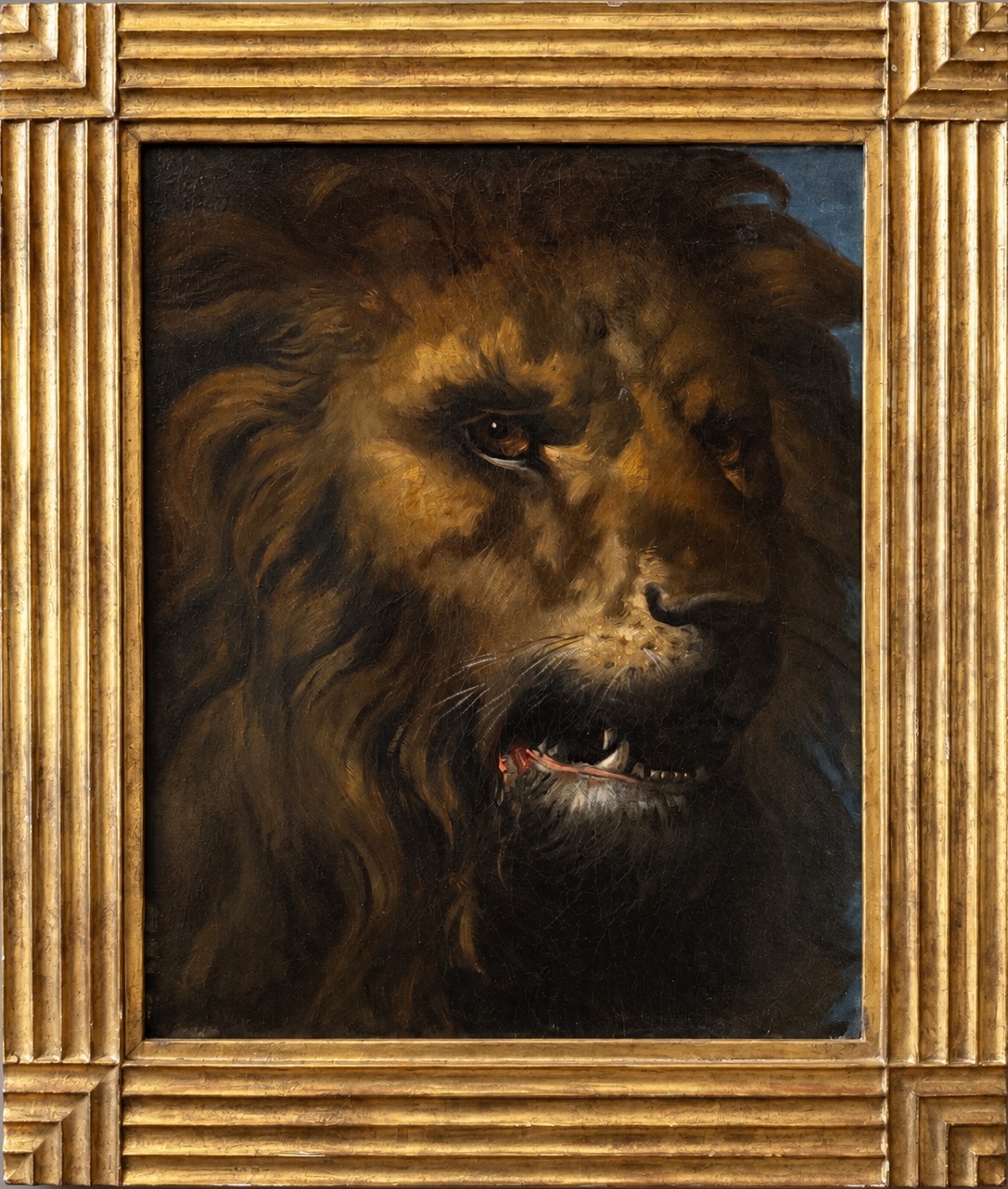
French School of the XIX Century
Head of a Lion
oil on canvas, 45,5 x 36; 18 by 14 inches
The intense study of a lion's head that we are analyzing today is certainly the work of a French artist from the nineteenth century. The interest in France for the representation of animals is particularly prevalent during the nineteenth century, also due to the fact that two important painters, Theodore Gericault and Eugene Delacroix, repeatedly engaged with this genre of subjects.
Gericault's interest primarily focuses on horses; perhaps the influence of Horace Vernet and his father Carle played a fundamental role in Theodore's development of a passion for representing horses.
Speaking of large felines, it is impossible not to mention Delacroix, who makes this genre of paintings a constant in his production. However, it is important to immediately distinguish between the works of Eugene and the one we are analyzing today. Delacroix's interest in large felines, particularly tigers and lions, is more confined to the dynamism of their bodies and movements. What interested the painter most was capturing the moment: a leap, a bite, a roar. This does not mean that he neglected proportions or did not carefully study the figures; quite the contrary. Indeed, we find a significant number of drawings and sketches where Delacroix thoroughly studies the anatomical structure and movements of these animals; nevertheless, the painter's genius lies in painting with speed, in a flurry, prioritizing dynamism over naturalism.
This is certainly not the case with our painting, which depicts a three-quarter view of a lion, almost as if it were the portrait of a nobleman. The artist in question bestows upon the lion an expression almost human, far from the animal ferocity that instead interested Delcroix, as is evident in the wonderful painting in figure 1, where a lion and a tiger confront each other without holding back.
It is unlikely that our canvas represents only a fragment of a larger painting, confirming that our painter was interested in "portraying" the animal, rather than narrating its bestial habits. Each individual hair is painted with extreme meticulousness, with confident and strong yet accurate brushstrokes, just as with the eyes, which conceal a human depth and make the gaze of our feline memorable. In the absence of further information, including its provenance, it would be speculative to propose an attribution. What is certain, however, is that we are facing an extraordinary example of French painting from the nineteenth century, capable of breaking away from the conventions imposed by such monumental figures as Theodore Gericault and Eugene Delacroix.